

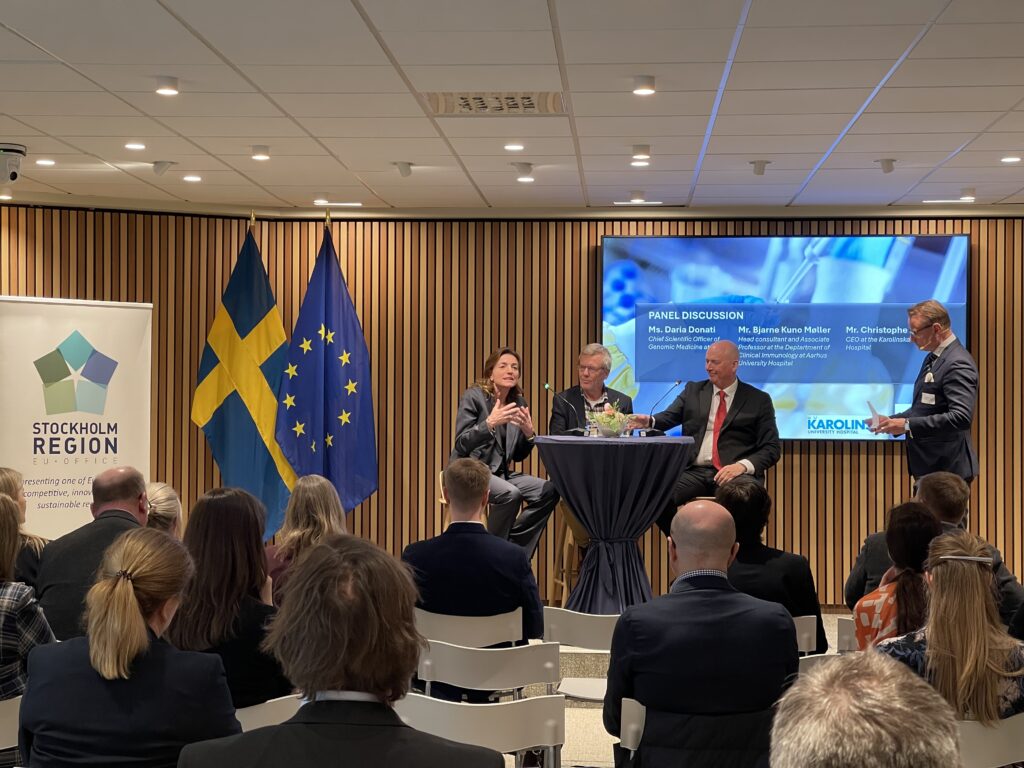
On Thursday the 23rd of April the Stockholm Region EU Office, Karolinska University Hospital and the Permanent Representation of Sweden to the EU, together organised a high-level seminar on Building a Stronger Europe, the Nordic-Baltic Cooperation in Health Innovation and a Spotlight on Advanced Therapy Medicinal Products (ATMPs). (Svensk version nedan)
Life Sciences and ATMP
In 2025 Karolinska University hospital together with Karolinska University Hospital became an ATMP centre. Being an ATMP centre covers a wide range of purposes and therapies, from advanced cell and gene therapy to creating new strategies to attack previously untreatable diseases. Karolinska University Hospital has now, together with a Nordic-Baltic consortium consisting of several leading European University Hospitals, sent in a joint application to a call from the EU to establish up to ten Centres of Excellence in ATMP. ATMP plays a vital role in the European commission’s Life Sciences Strategy, and the aim of the call is to strengthen Europe’s capacity to develop, manufacture and implement advanced therapies.
Building a Stronger Europe
The seminar discussed the current and future policy landscape for innovative health in the EU and highlighted the Nordic-Baltic collaboration within life sciences, as well as what the EU should prioritise to accelerate innovation, access and competitiveness. It focused specifically on advanced therapy medicinal products (ATMPs) and in this context highlighted best-practice examples of international cooperation from the Nordic–Baltic region.
 The seminar was moderated by Mr. Matti Sällberg, Professor in Analytical Biomedicine and Researcher for Vaccine at Karolinska Institute, and was opened by Ms. Åsa Webber, Deputy Permanent Representative of Sweden to the EU, highlighting the Nordic-Baltic region as an excellent hub for life sciences. Ms. Webber emphasized that establishing a network of ATMP centres of excellence is essential for driving innovation forward across the European Union and that it is made possible through collaboration.
Ms. Talla Alkurdi, the Regional Healthcare Commissioner for Region Stockholm, continued the seminar with sharing a vision where Karolinska University Hospital plays a leading role in a united Nordic effort. Ms. Alkurdi noted that collaboration and the sharing of resources can create “true miracles,” providing hope to patients who previously faced untreatable conditions.
“I’m so happy for this united effort to create a Nordic ATMP Centre of excellence at Karolinska. Because when we collaborate, when we share knowledge and resources, true miracles can happen. In the end, it’s about giving people the most precious gift of all: Hope. That even more people, who once thought all hope was lost, will one day hear the words: “We have a new treatment. We can help you”. That is our vision in Region Stockholm. “– Talla Alkurdi.
 Mr. Knut R. Steffensen, the Director for Karolinska ATMP Centre, emphasised the importance of cooperation and working together to make Europe more competitive. As well as the need for industry and non-industry to work together. Mr. Steffensen stressed that the consortium for this application consists of 90 actors and that Karolinska University hospital will strengthen its position while simultaneously contributing and driving the entire region forward. With Karolinska University Hospital as a hub, the Nordic-Baltic region can become competitive in an international context. Mr. Steffensen also talked about the changing role of universities and hospitals in Europe, and that hospitals also contribute to the economy through companies and innovations. Mr. Steffensen concluded by saying that the application is submitted and hopefully Karolinska University hospital becomes a European centre of excellence, but also that the consortium has built a strong Nordic-Baltic cooperation and will continue to work together.
“We want to accelerate the best possible care to our citizens and ATMPs are at the heart of transformative medicine. That’s why we need European Centres of Excellences for ATMP, and the Nordic-Baltic cooperation is a network that can strengthen cross regional cooperation, the European ecosystem, and European competitiveness” – Knut Steffensen.
Ms. Ann-Sofie Rönnlund, Member of the Cabinet of Commissioner Zaharieva, shared the cabinet’s ambitious goal to make Europe a leader in life sciences. According to Ms. Rönnlund, the general approach to achieving this goal consists of three objectives; more research in the area, speed up clinical research and trials and cooperation through networks like this consortium. Ms. Rönnlund underlined the importance of the engagement on the topic at the event and how treatments with ATMP can help change and save lives.
The Nordic-Baltic Cooperation
The panel discussion gave insight in how different actors are needed for a successful European ATMP strategy. The Director at the Karolinska University Hospital, Mr. Christophe Pedroletti emphasized that collaborations like this Nordic Baltic effort are essential for being able to treat more patients. The Head consultant and Associate Professor at the Department of Clinical Immunology at Aarhus University Hospital, Mr. Bjarne Kuno Møller, agreed and added that because many ATMP patients have rare diseases, cross-border collaboration is necessary to make treatments viable for such small groups. Mr. Møller said that to solve this issue of treatments becoming more viable for more patients and would like to see sustainable platforms for treatments so that doctors won’t have to start over again for each new patient.
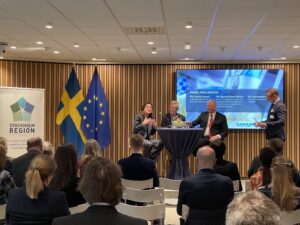
Chief Scientific Officer of Genomic Medicine at Cytiva, Ms. Daria Donati, lifted the industry’s role to be ready to easily supply the hospitals with the right equipment needed for these advanced therapies. Ms. Donati also discussed the importance of the “Triple Helix”, the collaboration between industry, university, and hospital, to provide the technical platforms and manufacturing capabilities needed to scale treatments.
Mr. Pedroletti added that if Karolinska University Hospital becomes an ATMP centre of excellence, it means that more patients will be able to be treated. Mr. Pedroletti highlighted that while competitiveness between universities and hospitals can drive excellence, it is important to remember that treating patients is the most important and that is why collaboration matters.
What are the next steps
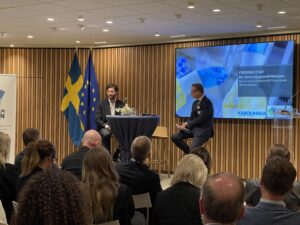
After the panel discussion, Mr. Boris Ajeganoff-Nielsen, Senior Policy Advisor to MEP Stine Bosse (Renew Europe) took the stage for a fireside chat together with the moderator Mr. Matti Sällberg, Professor in Analytical Biomedicine and Researcher for Vaccine at Karolinska Institute. Mr. Ajeganoff-Nielsen discussed the importance of scaling up the life sciences sector, successfully commercializing the products produced and how competition within a healthy ecosystem can lower the cost for ATMPs and thus making it more available for patients. Consortia like the Nordic-Baltic effort can help drive ATMP innovation and availability forward. To conclude the session, Mr. Ajeganoff-Nielsen emphasised that scaling up the ATMP, and thus the Life Sciences sector, would not only benefit the patients but may also result in an advantageous position for the European Union and be a huge driver of economic growth.
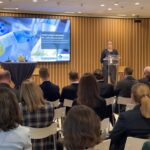 Ms. Sofia Wennerstrand, Counsellor for Health and Pharmaceuticals at the Swedish Permanent Representation, concluded the seminar by stressing the importance of building an efficient European ecosystem for ATMPs that will benefit industry, economy and patients. Ms. Wennerstrand ended by underlining the Nordic-Baltic consortium collaboration, emphasising that consortia like these strengthens Europe’s capacity to efficiently scale up its Life Sciences sector.
/Inez Volaire-Ekblad, trainee och Rebecca Timm, Communication Strategist at Stockholm Region EU Office